WELCOME TO SEASON 8 OF BUSINESS OF CRAFT
Welcome to Business of Craft, a show designed to help entrepreneurs with fabric or fiber businesses become more successful.
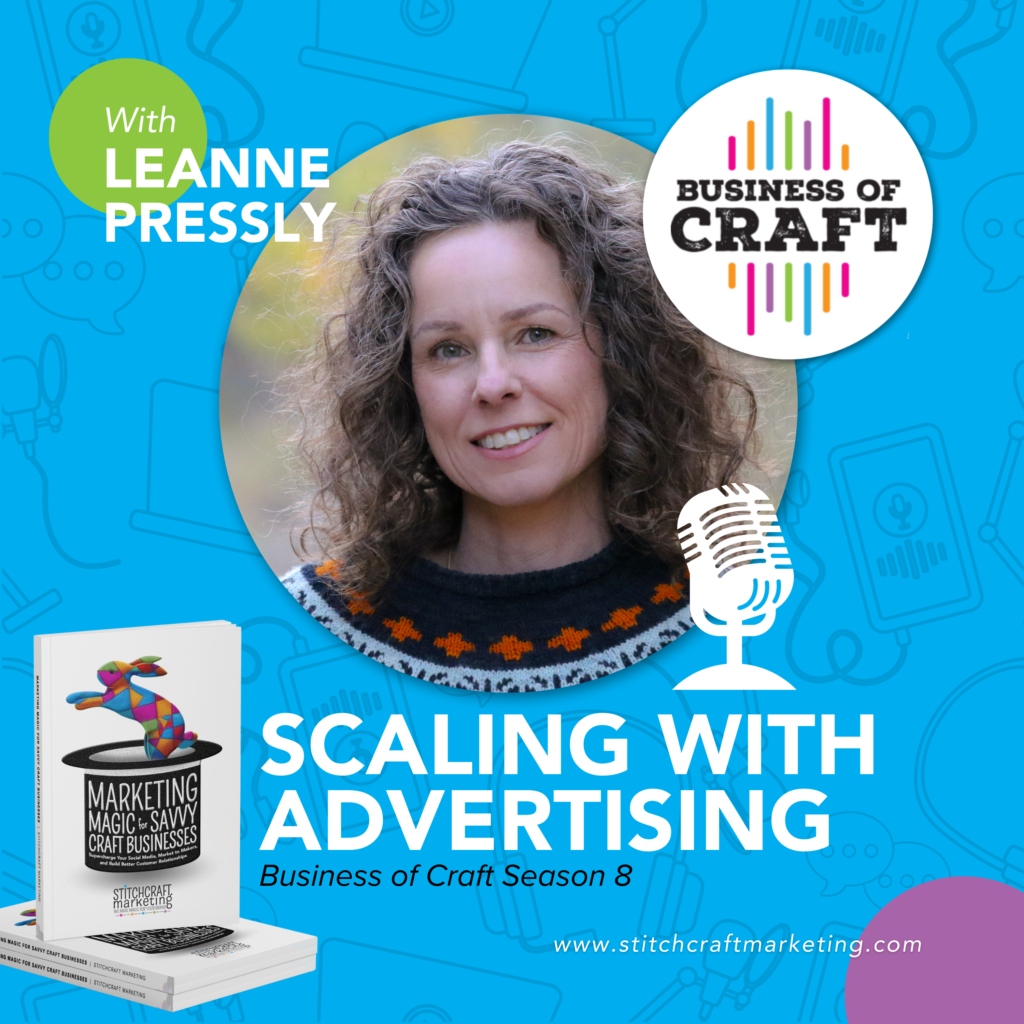
This is our 8th season of BOC and today we have another solocast to cover one of the topics in our new book, Marketing Magic for Savvy Craft Businesses. I’m super proud of this book which my whole team wrote in 2025. The book is available for sale in Kindle and print version (and soon to be audio) on our website or Amazon.
Listen to the Show:
Listen to it on Spotify, iHeartRadio, iTunes, and PlayerFM, or catch the video version on YouTube.
Thank you for taking the time to listen! If you’re enjoying the show, it’s safe to assume there are others out there like you who would also enjoy the show. Help them find it by leaving a review on your favorite podcast platform. Don’t forget to subscribe to stay on top of the latest episodes!
Today we’re exploring how to scale your brand using digital advertising—yes, the kind that doesn’t have to feel like throwing spaghetti at the wall.
So whether you’re boosting posts or venturing into more advanced ad strategies like programmatic or geofencing, this episode is your incantation for attracting, converting, and scaling.
You’ve got a budget. You’ve got goals. And now you want results.
The world of digital advertising can feel like a vast enchanted forest—but with the right map, you can walk confidently toward your desired outcome. The key is alignment. Your budget, your audience, your ad content, and your chosen platform all need to be working toward one goal—whether that’s brand awareness, online sales, or growing your newsletter list.
Start by clarifying your objectives. Are you trying to attract new eyes to your business? Drive more e-commerce conversions? Maybe get more people into your brick-and-mortar shop? Whatever your aim, your ad strategy should be a match—not a mismatch.
Let’s talk targeting—because the real magic of digital ads isn’t just showing up, it’s showing up in the right place, for the right people.
Here are a few tools I love for getting precise:
- Behavioral & Interest-Based Targeting: Platforms like Meta and Google let you segment audiences by interests like quilting, crafting, or fiber arts.
- Retargeting: This is for people who’ve visited your website but didn’t take action. You’re giving them a gentle nudge back into your world.
- Email Audience Targeting: You can upload your customer list and run ads directly to them or lookalike audiences who mirror them.
- Geotargeting & Geofencing: Want to show ads to people at a local quilt show or fiber festival? You can draw a virtual boundary around that event and deliver ads in real time.
- Search ads— especially on Google where you appear as the first search result.
You don’t need a six-figure budget to make digital advertising work for you. One of the best places to start is by boosting a post on Facebook or Instagram—especially a post that’s already performing well organically.
From there, you can explore:
- Instagram Stories & Reels Ads
- Google Search & Display Ads
- Pinterest Shopping Pins
- YouTube Pre-Roll or Shorts Ads
Test small. Scale what works. Drop what doesn’t.
This isn’t a print ad where you pay once and hope for the best. This is interactive, real-time, trackable advertising.
Let’s demystify two of the fancier-sounding ad options out there: Programmatic Advertising and Geofencing.
- Programmatic Ads: These are automatically placed based on your target audience’s behavior. For example, someone reading a DIY blog might suddenly see your ad for a new quilting pattern—on a completely unrelated site. Creepy? Maybe. Effective? Absolutely.
- Geofencing: This uses GPS data to target users within a virtual perimeter. Let’s say you set up a geofence around a fiber arts festival—anyone inside that radius sees your ad. You can even retarget them later based on that interaction.
The secret to smart advertising isn’t spending more—it’s spending smarter. Here’s how to stretch your budget:
- Start with your high-ROI platforms. For craft businesses, Facebook, Instagram, Pinterest, and YouTube tend to offer the best return.
- Monitor your Key Performance Indicators—click-through rates, cost-per-click, conversions, and sales.
- Reallocate budget regularly to the best-performing campaigns.
And don’t be afraid to pause ads that aren’t working—unlike print, you’re not locked in.
Digital ads aren’t one-and-done—they’re part of your long-term brand-building toolkit. As you gather data, start making strategic decisions:
- Double down on high-performing content types (carousel, video, testimonials).
- Invest more in the platforms that generate conversions, not just clicks.
- Segment audiences so returning customers see one message, and new leads see another.
Remember: advertising isn’t a gamble when you’re tracking, learning, and adapting. It’s an engine for growth.
Before we wrap, a quick word on using tools like ChatGPT in your ad strategy. AI can be a fantastic sidekick for:
- Writing ad outlines
- Brainstorming headlines
- Creating multiple ad variations
- Drafting short-form copy
BUT—and this is important—don’t rely 100% on AI. Why?
Because AI doesn’t know your customers like you do. It doesn’t understand the nuances of your brand voice, your product quirks, or your community vibe. And worst of all, it can sometimes be…well, boring. Or inaccurate.
Digital advertising isn’t about shouting into the void. It’s about casting a well-aimed, data-backed spell that attracts the right people to your brand—and invites them to take action.
Start small. Stay strategic. Let the data guide you. And don’t forget—you are the magic behind the message.